
Analysis date: 12 September 2026
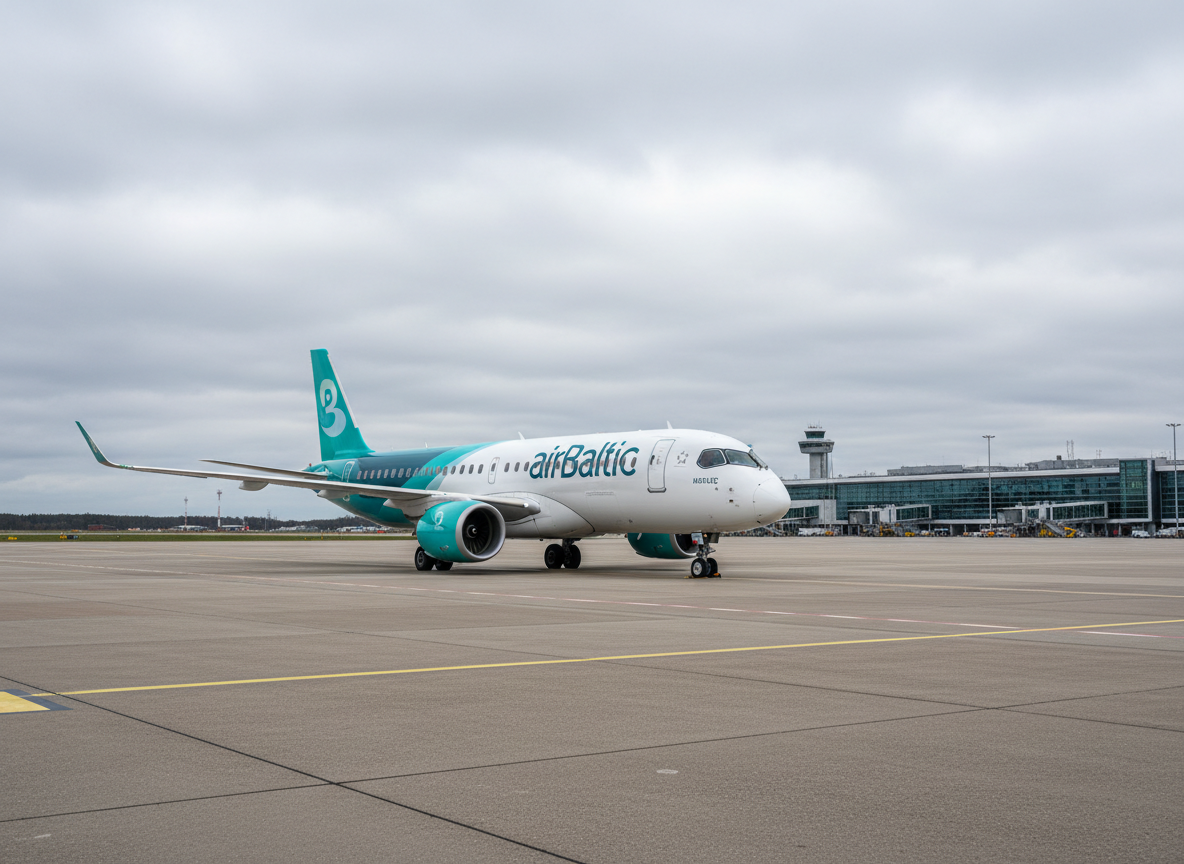
Key takeaway: airBaltic just closed its best revenue year in history and cleared the Pratt & Whitney engine problem that once grounded a third of its fleet, yet on 15 September 2026 its bondholders vote on lending the airline up to €257 million at 25 percent annual interest simply to keep it flying through the winter. This is not primarily a demand problem or a product problem — it is a balance-sheet problem, and it is forcing airBaltic to shrink its in-service fleet from 54 Airbus A220-300s toward roughly 36 by year-end, a sharp retreat from the 100-aircraft ambition that once sat behind its planned IPO.
A €257 million lifeline, priced at 25 percent
airBaltic is seeking up to €257 million of new super-senior financing, split into a €180 million first tranche (€189.5 million face value, issued at 95 percent) available immediately on approval, and a conditional €77 million second tranche (€81.1 million face value). The new bonds carry 25 percent annual interest with monthly compounding through maturity on 26 February 2027, rising by a further 10 percentage points if the airline defaults. Collateral pledged against the new money includes eight A220-300 aircraft, seven Pratt & Whitney PW1521G spare engines, shares in leasing entities, lease and insurance assignments, bank accounts held outside Latvia, and the existing collateral package behind the airline’s 2029 bonds, meaning the new lenders would sit ahead of airBaltic’s own €380 million bondholders in a restructuring. Airways Magazine’s reporting on the financing terms.
The bondholder meeting was originally set for 11 September 2026 and was postponed to give creditors more time to review the resolution and submit voting instructions. It has been rescheduled for 15 September 2026 at 12:00 GMT (15:00 Riga time). Fitch has described the airline’s alternatives as “quite limited” if the proposal is rejected.
An August rescue that bought time, not a solution
The September vote is not the first ask this year. airBaltic unveiled a revised business reorganisation plan on 11 August 2026, and on 17 August more than 75 percent of represented bondholders approved amendments to the existing €380 million, 14.5 percent bonds due 2029: interest payments due on 14 August and 14 November 2026 will be added to the bonds’ principal rather than paid in cash, and minimum-liquidity covenants were waived through 14 November 2026. AeroTime’s coverage of the August vote. That vote bought breathing room. It did not raise new cash. The €257 million super-senior facility now up for approval is the much larger, and much more expensive, second step.
The strange part: the airline itself is improving
Set against that financing scramble, airBaltic’s operating numbers tell a genuinely different story. In 2025 the airline generated record revenue of €779.3 million, up 4 percent year-on-year, carrying 5.2 million passengers on its own network and flying 78,400 total flights including ACMI. The net loss narrowed sharply to €44.3 million from €118.2 million in 2024, although adjusted EBITDAR margin fell to 18.5 percent from 24.6 percent on €143.9 million of adjusted EBITDAR. airBaltic’s 2025 results.
The first quarter of 2026 showed the same pattern. Revenue rose 12 percent to €149 million, passenger revenue increased 8.2 percent, and ACMI revenue jumped almost 29 percent to €21.3 million, while adjusted EBITDAR turned to a €7 million profit from a €4.3 million loss in Q1 2025. Yet the net loss widened to €70.1 million, with roughly €36.5 million of the deterioration coming from currency revaluation of US-dollar liabilities and the remainder linked to lower Pratt & Whitney compensation. airBaltic’s Q1 2026 results. Revenue, ACMI income and adjusted EBITDAR are all moving the right way; net losses, driven substantially by non-operating items like FX revaluation, are not.
What the balance sheet actually shows
At 31 March 2026, airBaltic reported around €16 million of unrestricted cash alongside €17 million of restricted cash, against roughly €473 million of borrowings and close to €884 million of current and non-current lease liabilities. Total equity stood at negative €249 million. Negative equity is not automatically fatal for an airline carrying substantial lease obligations, and accounting values can overstate the gap between operating health and financial health. But the combination of thin available cash, expensive debt and continued net losses leaves very little capacity to absorb another shock, which is exactly what arrived next.
Geopolitics and an unhedged fuel book, at the worst possible time
The escalation of conflict in the Middle East forced airBaltic to suspend services including Dubai and Tel Aviv and redeploy aircraft elsewhere in the network, trimming its spring and summer flying programme. At the same time, fuel prices rose sharply. In March 2026 airBaltic unwound its remaining 10 percent fuel hedge for roughly €5.1 million of immediate cash, a decision that helped short-term liquidity while leaving the airline to enter the rest of 2026 essentially unhedged on fuel, just as prices moved against it.
The A220 problem is finally fixed — just as the fleet gets cut anyway
airBaltic built one of the world’s largest all-Airbus A220-300 fleets, and Pratt & Whitney’s geared-turbofan engine problems left a meaningful share of it grounded for inspection in prior years: an average of 13 aircraft were unavailable in Q1 2025, falling to zero by Q1 2026. That operational win arrived just as the restructuring plan calls for cutting the in-service fleet from 54 A220-300s to roughly 36 by the end of 2026, before rebuilding gradually to around 40 by 2031 — a fraction of the roughly 100-aircraft fleet once targeted under the airline’s IPO-era growth plans. ch-aviation’s reporting on the fleet plan.
ACMI, Lufthansa, and a strategy that is pulling back, not scaling up
Under an ACMI contract, airBaltic supplies another airline with aircraft, crew, maintenance and insurance, and this has quietly become one of its most important businesses: 30,100 ACMI flights in 2025, up 15 percent year-on-year, and Q1 2026 ACMI revenue up almost 29 percent to €21.3 million, with an average of roughly nine aircraft, peaking at ten, deployed on ACMI work during the quarter. Lufthansa Group bought a 10 percent stake in airBaltic in 2025, took a Supervisory Board seat, and described the investment as an extension of its existing wet-lease relationship with the carrier. Lufthansa’s 10 percent investment. As of Q1 2026, ownership stood at Latvia 88.37 percent, Lufthansa Group 10 percent, Aircraft Leasing 1 SIA, tied to private investor Lars Thuesen, at roughly 1.62 percent, and other holders at 0.01 percent.
Yet despite ACMI’s growth, the government’s own restructuring plan explicitly calls for reducing airBaltic’s exposure to the open ACMI market alongside the fleet cut and network contraction. Not all wet-lease flying is being treated as equally valuable: the anchor relationship with Lufthansa looks set to matter far more going forward than opportunistic spot-market ACMI capacity.
What happened to the IPO?
For years, a public listing was presented as airBaltic’s natural next step: new capital, a reduced Latvian ownership stake, and a platform for growth toward a 100-aircraft fleet. Lufthansa’s investment was even structured so its holding could convert into ordinary shares around a future listing. Today, an IPO looks far more distant. Public-equity investors want a credible path to free cash flow and a manageable capital structure, and airBaltic must resolve its financing structure before that case can realistically be rebuilt. Survival and recapitalisation come first. A listing could return to the agenda eventually, but the airline will likely look structurally different, smaller and more concentrated, by the time it does.
A Riga-first restructuring, and a precedent worth watching
Latvia has described the revised business plan as centred on a more concentrated network around Riga, fleet optimisation and tighter financial discipline, explicitly moving away from maximising the number of aircraft operated toward maximising the economic value each aircraft produces. That is a familiar arc in European aviation: this site has already covered how Norwegian’s own balance-sheet crisis and restructuring a decade ago forced a similarly painful shrink-to-grow reset before it returned to a smaller, more disciplined footprint. airBaltic now looks set to follow a comparable path, with Riga playing the role Oslo once did for Norwegian.
What happens next
The immediate milestone is the rescheduled bondholder vote on 15 September 2026. Approval buys airBaltic time; it does not solve the underlying problem. Short-term super-senior financing at 25 percent simply moves the next major financing decision further into 2027. A genuine long-term recapitalisation will still require some combination of new equity, a strategic investor, further debt restructuring, the completed fleet optimisation, and sustained profitability. If the vote fails, Fitch has already flagged the alternatives as limited, and the coming weeks would carry outsized influence over the ownership structure and strategic direction of Baltic aviation for years to come.
The bigger lesson
airBaltic is a reminder that airline success cannot be measured by revenue, passenger growth or fleet size alone. A modern, single-type fleet does not guarantee a sustainable airline. Neither does record revenue, a growing ACMI business, or a strategic tie-up with one of Europe’s largest carrier groups. Even clearing a years-long operational constraint, as airBaltic did with its Pratt & Whitney groundings, cannot compensate for a capital structure the airline grew faster than it could support. The next phase is unlikely to be about rebuilding airBaltic from scratch. It will be about deciding which, smaller, version of airBaltic is worth financing, and on what terms.
Note: this article was published on 12 September 2026, before the rescheduled 15 September bondholder vote, and reflects information available at the time of publication. Figures are company-reported as cited throughout. This article is for information purposes and is not investment advice. Company profile source
Tables and key figures
airBaltic FY2025 at a glance
| Metric | FY2025 | FY2024 | Change |
|---|---|---|---|
| Revenue | €779.3m | €749.3m | +4% |
| Net result | −€44.3m | −€118.2m | Loss narrowed |
| Adjusted EBITDAR | €143.9m | — | Margin 18.5%, down from 24.6% |
| Passengers (own network) | 5.2m | — | — |
| Total flights incl. ACMI | 78,400 | — | — |
| ACMI flights | 30,100 | — | +15% |
Q1 2026 and balance sheet snapshot
| Metric | Value | Context |
|---|---|---|
| Q1 2026 revenue | €149m | +12% year-on-year |
| Q1 2026 ACMI revenue | €21.3m | +29% year-on-year |
| Q1 2026 adjusted EBITDAR | +€7m | Versus −€4.3m in Q1 2025 |
| Q1 2026 net loss | −€70.1m | ~€36.5m from FX revaluation of USD liabilities |
| Unrestricted cash (31 Mar 2026) | ≈€16m | Plus ≈€17m restricted |
| Borrowings (31 Mar 2026) | ≈€473m | — |
| Lease liabilities (31 Mar 2026) | ≈€884m | Current + non-current |
| Total equity (31 Mar 2026) | −€249m | Negative equity |
September 2026 interim financing terms
| Term | Detail |
|---|---|
| Total facility | Up to €257m across two tranches |
| Tranche 1 | €180m gross cash (€189.5m face value, 95% issue price), immediate on approval |
| Tranche 2 | €77m gross cash (€81.1m face value), conditional |
| Interest | 25% per year, monthly compounding; +10pp on default |
| Maturity | 26 February 2027 |
| Ranking | Super-senior; ahead of existing €380m, 14.5% 2029 bonds |
| Collateral | 8 A220-300 aircraft, 7 PW1521G engines, leasing-entity shares, lease/warranty/insurance assignments, offshore accounts, 2029-notes collateral package |
| Vote date | 15 September 2026, 12:00 GMT (postponed from 11 September) |
Fleet plan and ownership
| Milestone | Fleet (A220-300) |
|---|---|
| Prior IPO-era ambition | ~100 aircraft |
| Current in-service fleet | 54 |
| Target, year-end 2026 | ~36 |
| Target, 2031 | ~40 |
| Shareholder | Stake |
|---|---|
| Government of Latvia | 88.37% |
| Lufthansa Group | 10.00% |
| Aircraft Leasing 1 SIA (Lars Thuesen) | 1.62% |
| Other holders | 0.01% |