
Analysis date: 17 September 2026
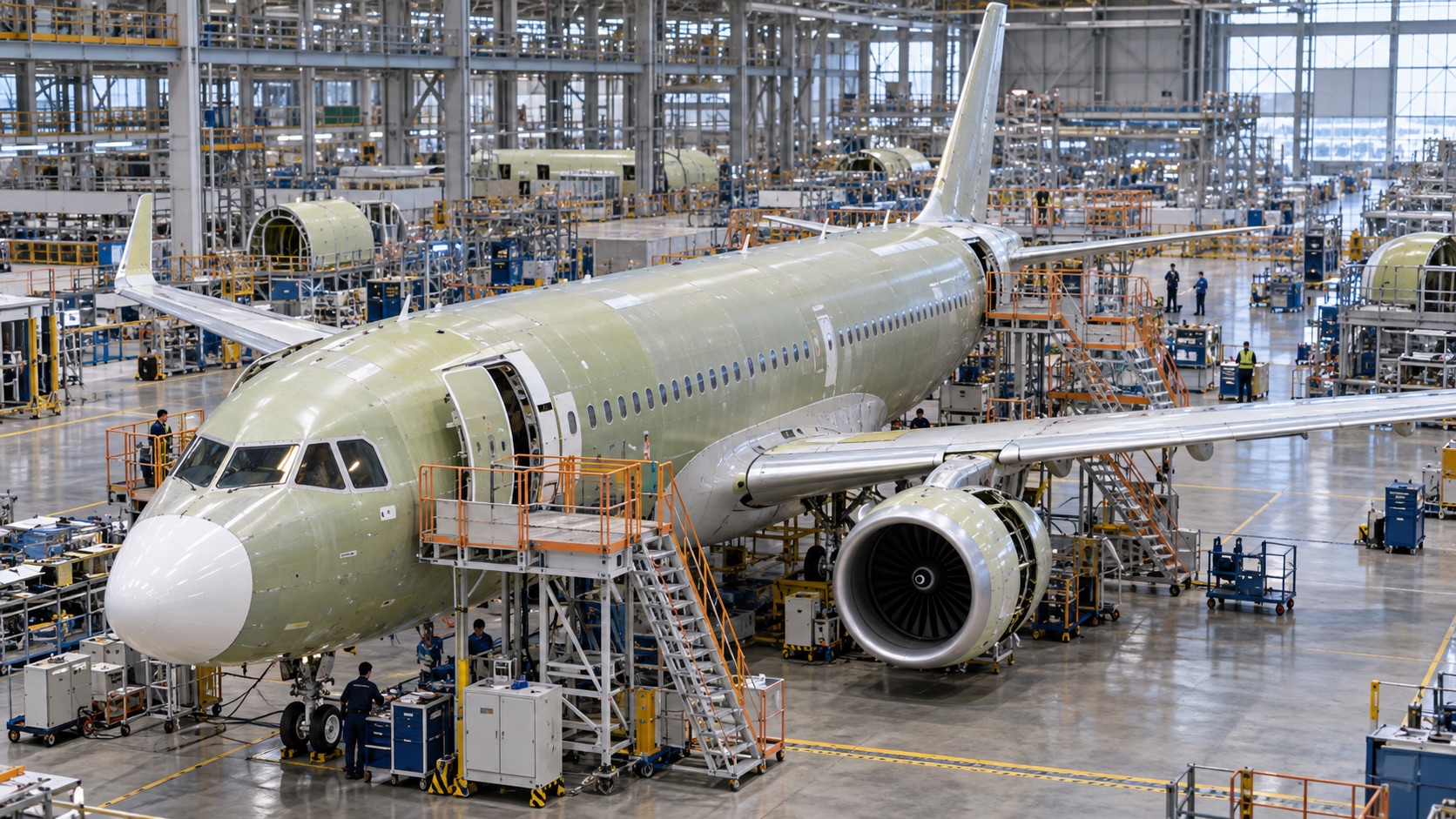
Illustrative image generated with AI. It does not show a Boeing facility.
Key takeaway: Boeing still expects positive free cash flow in 2026, but a slower ramp in 737 and 787 production has made the top end of its $1 billion–$3 billion guidance less likely. Chief financial officer Jay Malave now frames roughly $2 billion as the more realistic outcome. That would mark progress after years of cash strain, yet Boeing’s approximately $25.9 billion of net debt at the end of June shows why a return to positive cash flow is only the beginning of its financial recovery. Boeing’s September investor event; second-quarter results.
The midpoint is becoming the working case
At the Morgan Stanley Laguna Conference on 16 September, Malave reaffirmed Boeing’s full-year free-cash-flow guidance of $1 billion to $3 billion. He said the company remained centred on the $2 billion midpoint, while higher deliveries in the second half—the route to exceeding that figure—had become less likely as production-rate increases moved later in the year. This is a change in the probability of reaching the upper end, not a withdrawal of the guidance range. Boeing investor event.
The distinction matters because Boeing’s recovery depends on converting aircraft in production into delivered aircraft and cash. A higher nominal rate does not immediately produce the same number of completed, accepted and paid-for jets. Boeing generated $631 million of free cash flow in the second quarter, but its first-half total was still negative $823 million. Reaching $2 billion for the year would therefore require roughly $2.8 billion of free cash flow in the second half. That calculation illustrates the scale of the required improvement; it is not a separate company forecast. Boeing second-quarter results.
The 737 constraint is inside the factory
Boeing is working toward 47 aircraft a month on the 737 programme, but chief executive Kelly Ortberg said the system had not yet stabilised at that rate. The immediate constraint is wing production in Renton, where the expected improvement in factory flow has taken longer than planned. Before Boeing can advance to 52 a month, it also needs its new 737 line in Everett to be producing aircraft. Ortberg indicated that the next rate increase would follow once those conditions are met, rather than simply because demand or parts availability permits it. Boeing investor event.
That is an important qualification for airlines waiting on new capacity. Boeing’s second-quarter release said the 737 programme had begun transitioning to 47 a month. September’s update makes clear that transitioning to a rate and sustaining it reliably are different milestones. Until the wing shop and the additional line operate consistently, a faster delivery schedule remains dependent on execution inside Boeing’s production system. Boeing second-quarter results; September investor event.
The 787 has a different bottleneck
Ortberg said 787 production had stabilised at eight aircraft a month, but engine deliveries had not yet reached the level needed to move to ten. Boeing is working on a recovery plan with GE, and the prospective increase has shifted toward the end of 2026. Even at the present production rate, monthly deliveries may remain uneven: complex new seating configurations and their certification documentation can hold up completed aircraft without stopping their passage through the factory. Boeing investor event.
The financial effect is straightforward. Boeing can incur the costs of building an aircraft before collecting the cash associated with its delivery. A seat-certification delay is therefore different from an engine shortage on the production line, but both can postpone the cash conversion on which the second-half forecast relies.
Positive cash flow does not erase the debt burden
At 30 June, Boeing reported $45.9 billion of consolidated debt and $20.0 billion of cash and marketable securities. Subtracting the latter from the former gives approximately $25.9 billion of net debt. This is a simple derived measure, not a separate net-debt figure reported in Boeing’s results, and it describes the June balance sheet—not a newly reported September balance. The company also reported $10 billion of undrawn credit facilities. Boeing second-quarter results.
A $2 billion annual free-cash-flow result would be a meaningful turn into positive territory, but it is modest beside that debt stock. Free cash flow is also not identical to the amount automatically used to repay debt: Boeing defines it as operating cash flow less capital expenditure, and other financing needs and decisions still matter. The central financial question is whether 2026 establishes a repeatable rise in cash generation, rather than delivering a single positive year. Boeing second-quarter results.
What happens next
Three operating tests now carry particular weight: whether 737 wing production stabilises at 47 a month, whether the Everett line is ready to support a move to 52, and whether 787 engine supply permits a sustained increase beyond eight. Delivery timing matters alongside each production milestone. Boeing also expects aircraft built ahead of 737 variant certification to begin moving into customer hands after approval; the FAA certified the 737-7 in August, while the 737-10 remained in its certification process at the September investor event. Boeing investor event.
Malave expects cash flow to grow in 2027 but has not issued a figure for that year. He also cautioned that pricing penalties and the unwinding of excess customer advances would continue to weigh on cash generation. It would be premature to treat a higher future production rate as an immediate or proportional jump in free cash flow. Boeing investor event.
The bigger lesson
Boeing has substantial demand: its company-wide backlog stood at $715 billion at the end of June. Demand, however, is not the current limiting factor. The nearer-term test is whether the manufacturer can raise output without sacrificing stability, deliver the aircraft it builds, and turn that activity into cash at a pace that begins to reduce a still-heavy debt load. Around $2 billion of free cash flow in 2026 would show that recovery is underway. It would not, by itself, show that the recovery is complete. Boeing second-quarter results.
Tables and key figures
| Measure | Figure | Basis |
|---|---|---|
| 2026 free-cash-flow guidance | $1bn–$3bn | Reaffirmed 16 September |
| Management’s current working midpoint | About $2bn | CFO commentary, 16 September |
| First-half 2026 free cash flow | −$823m | Reported |
| Implied second-half cash flow to reach $2bn | About $2.8bn | Calculated from reported first half |
| Consolidated debt | $45.9bn | 30 June 2026 |
| Cash and marketable securities | $20.0bn | 30 June 2026 |
| Approximate net debt | $25.9bn | Debt less cash and marketable securities, calculated |
Note: This analysis reflects information available on 17 September 2026. Free cash flow is Boeing’s non-GAAP measure. Forecasts are subject to production, delivery and programme risks. This article is for information purposes and is not investment advice.