
Evergreen guide · Research date: 1 October 2026.
A passenger sees an airport as the place where a journey begins, connects or ends. For the airport operator, that journey creates several opportunities to earn revenue: from the airline using the infrastructure, from businesses serving the passenger, and from the use of airport land and buildings.
Those revenues must support an expensive business. Runways, terminals and baggage systems require substantial investment, while safe and reliable operations create costs even when traffic is quiet.

Airports make money by combining aviation services with commercial activities. Whether they make a sustainable profit depends on traffic, pricing, operating costs, regulation and the capital needed to keep the airport running.
The two main sources of airport revenue
Airport operating revenue is usually divided into aeronautical revenue, associated with aircraft and passenger use of aviation facilities, and non-aeronautical revenue, generated by commercial activities.
The boundary is not identical in every set of accounts, but the basic distinction is useful.
| Revenue category | Common sources | What the airport earns money from |
|---|---|---|
| Aeronautical | Landing charges, passenger charges, aircraft parking and terminal facilities | Access to aviation infrastructure and services |
| Commercial concessions | Shops, duty-free outlets, restaurants and cafés | The right to operate a business at the airport |
| Ground access | Car parking and rental-car concessions | Access, parking and related commercial arrangements |
| Property and other commercial activities | Non-aviation property leases, advertising and commercial space | Land, buildings and access to an airport audience |
Heathrow’s published conditions of use illustrate the aviation side. ACI World’s overview of non-aeronautical activities describes the commercial side.
Aeronautical revenue: charging for airport use
An airline’s airport bill can contain several components rather than a single fee for each flight.
Aircraft-related charges may reflect weight, noise, emissions, time of operation or time spent parked. Passenger charges may depend on the number and category of passengers using the terminal. Separate arrangements can cover gates, check-in facilities and other services. The exact structure varies by airport.
This means aircraft movements and passenger numbers affect revenue in different ways. A flight carrying more passengers can generate additional passenger-related income without creating another movement.
Schiphol, for example, describes its charging structure as including fees per passenger alongside an aircraft-related component. The enduring point is the structure, rather than any particular year’s tariff. Schiphol’s explanation of airport charges
The airport also does not automatically earn every payment associated with a flight. Airlines, ground handlers, government agencies and air navigation providers can be separate businesses. Heathrow’s guide to who does what illustrates these different responsibilities.
Commercial revenue: earning beyond the aircraft
Retail and restaurants turn passenger demand into commercial income. The important accounting distinction is that a shop’s sales are not automatically the airport’s revenue.
An independent retailer might pay rent or a concession fee linked to turnover. Contracts can include a minimum annual guarantee, giving the airport a contractual income floor while placing more traffic risk on the retailer. ACI discusses these arrangements in its white paper on airport concession agreements.
Consider a hypothetical concession paying the greater of a €1 million annual minimum or 15% of sales. At €10 million of sales, the airport receives €1.5 million. At €5 million, the percentage calculation produces €750,000, so the €1 million minimum applies, assuming the contract remains enforceable and unchanged.
The airport’s income is the concession payment. The retailer’s full sales belong to the retailer’s business. If the airport directly operates an outlet, the accounting and operating costs differ.
Other commercial activities include parking, advertising and property rentals. These diversify revenue, but many still depend on passenger demand: fewer travellers can mean fewer restaurant purchases and fewer parked cars. Property income can have a different exposure, depending on tenants and lease terms. There is therefore no universal commercial revenue share that every airport should achieve. ACI World on commercial revenue and its variation across airports
Why the type of passenger matters
Two airports handling the same number of passengers can generate different revenues because those passengers use different services.
A traveller beginning a trip at the airport might pay for several days of parking. A connecting traveller arriving by air does not create that same parking opportunity, but may buy food or shop between flights. These are different commercial opportunities, rather than a rule that one passenger type is always more valuable.
International routes, trip purpose, purchasing power, connection time and the mix of shops also affect what can be sold. Duty-free eligibility depends on the route and applicable rules; an international passenger is not automatically a duty-free customer. The EU’s traveller guidance illustrates why the distinction matters.
Passenger experience matters commercially too. Predictable processing and clear wayfinding can give travellers more confidence about the time available before boarding. Queues that consume that time reduce the opportunity to browse or eat. ACI’s work on customer experience and commercial revenue connects these operational and commercial considerations.
For analysis, the implication is straightforward: passenger growth and revenue growth need not move at the same rate. A change in traffic mix can change revenue per passenger even when headline traffic increases.
The cost structure: substantial costs before the next passenger arrives
An airport needs staff, maintenance, utilities, cleaning, systems and emergency capabilities. Some costs rise with traffic, but others cannot be reduced quickly when fewer people travel.
An airport cannot remove a proportion of its runway or baggage system because traffic falls for a month. Staffing and contracted services can also be relatively fixed over short periods. ACI’s analysis of airport infrastructure costs explains this limited short-term flexibility.
That creates operating leverage. When an airport has spare capacity, additional traffic can spread existing costs over more passengers and improve profit. When traffic falls, revenue can decline faster than costs.
The benefit has limits. A crowded airport may need another pier, a larger terminal or new equipment to accommodate further growth. Costs then increase before the additional capacity is fully used. ACI describes this relationship between scale and investment in its explanation of the airport development cycle.
A worked example: revenue, profit and cash are different
Consider a hypothetical airport handling 10 million passenger movements a year. All figures below are illustrative and exclude grants, restricted project charges and exceptional items.
| Measure | Annual amount |
|---|---|
| Aeronautical revenue | €120 million |
| Commercial revenue | €80 million |
| Total operating revenue | €200 million |
| Operating costs before depreciation and amortisation | €110 million |
| EBITDA | €90 million |
| Depreciation and amortisation | €35 million |
| Operating profit | €55 million |
| Net interest expense | €20 million |
| Profit before tax | €35 million |
| Tax expense | €8 million |
| Net profit | €27 million |
The airport earns €20 of total revenue per passenger movement: €12 aeronautical and €8 commercial. These are blended ratios using total passenger movements, not tariff rates charged to each departing passenger. Movements are also different from unique travellers: someone departing and later returning contributes a departure and an arrival.
Its EBITDA margin is 45%: €90 million divided by €200 million. EBITDA means earnings before interest, tax, depreciation and amortisation. After depreciation and amortisation, its operating margin is 27.5%. After interest and tax, its net margin is 13.5%.
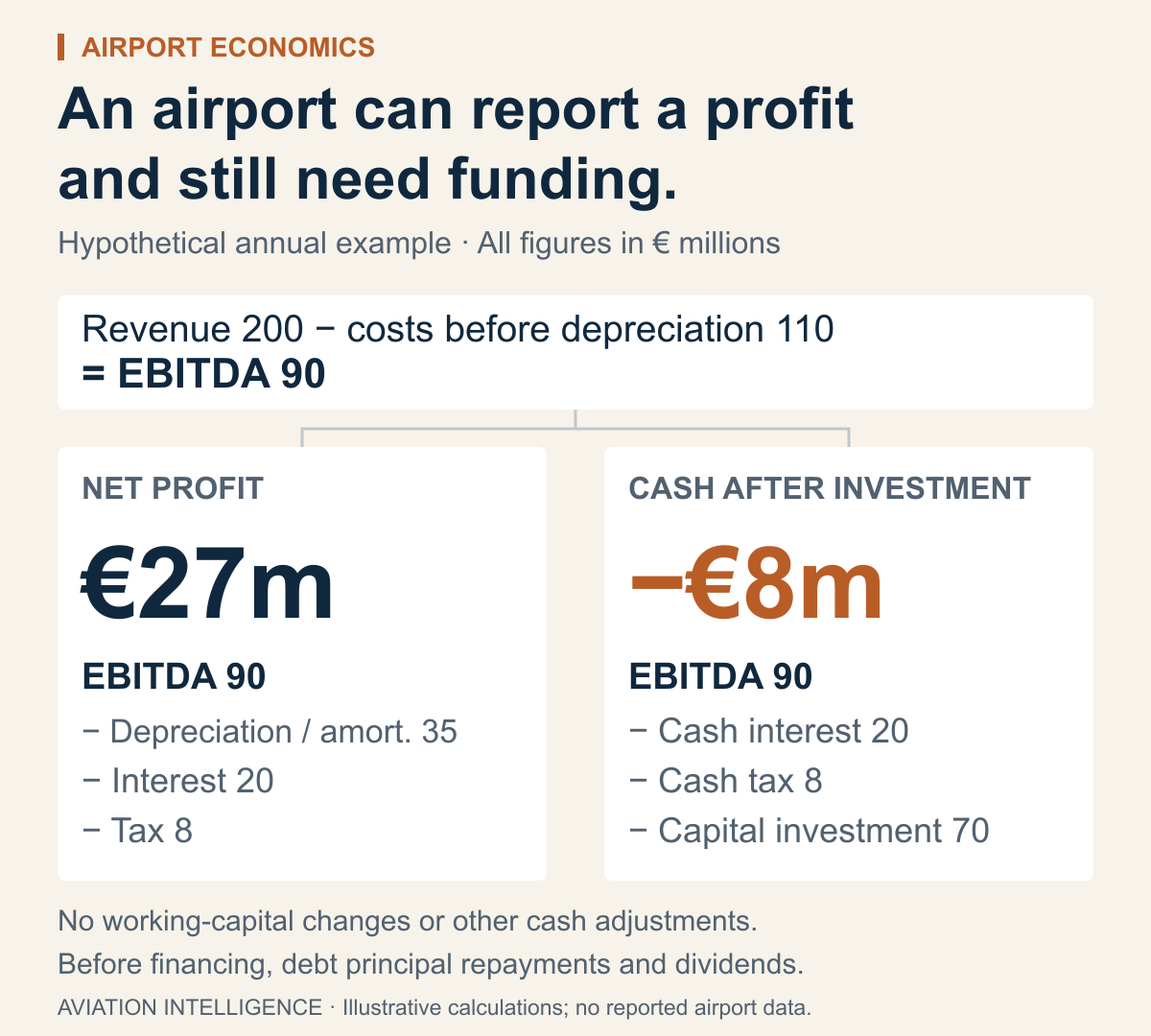
Now consider cash. Assume no working-capital changes, that interest and tax cash payments match the expenses above, and no other cash adjustments. Cash available after those payments is:
€90 million − €20 million − €8 million = €62 million
If the airport spends €70 million on capital investment, cash after that investment is negative €8 million, before new financing, debt principal repayments or dividends.
The airport reports a profit but needs funding for its investment programme. Depreciation spreads an asset’s cost across its useful life; capital expenditure is the cash spent on acquiring or improving the asset. They are different measures.
This example also shows why an EBITDA margin alone cannot establish financial strength. Investment requirements and financing obligations can absorb much of the apparent surplus.
The amount of capital invested matters too. If the hypothetical airport’s average capital employed is €1.1 billion, its €55 million operating profit represents a 5% pre-tax return on capital employed. A high margin on revenue can coexist with a modest return on a large asset base. Assessing value creation requires a consistently defined capital return and an appropriate cost-of-capital comparison.
Regulation shapes what an airport can charge
Airport pricing depends on the local framework. Some operators negotiate commercial agreements with airlines; others face economic regulation of charges. Heathrow is an example of an airport subject to regulatory price controls. UK Civil Aviation Authority’s Heathrow regulation overview
One particularly important distinction is how commercial activities enter the calculation of aviation charges:
- Single till: commercial income is taken into account when establishing the airport’s aviation charging requirement, helping offset costs recovered from airport users.
- Dual till: aviation and commercial activities are separated for this purpose, so commercial income does not directly offset the aviation cost base.
- Hybrid till: some combination of the two approaches applies.
The details determine how costs, income and risks are allocated. These models concern the basis for charges; they do not mean the airport has one, two or three physical pools of cash. ICAO Airport Economics Manual, section 4.121
The analytical implication is that an extra euro of commercial income may have a different effect on the operator’s long-term earnings under different charging arrangements. Revenue opportunity and the rules governing its recovery must be considered together.
Why airports cannot simply raise prices indefinitely
Commercial bargaining power varies. Airlines can redirect some routes and aircraft, while passengers may have alternative airports. Other locations have limited substitutes, constrained capacity or airlines with substantial investments tied to a particular hub. The European Commission’s evaluation of airport charging rules describes these differences in competitive conditions.
An airport seeking more traffic must therefore assess what a new route contributes after discounts, incentives and additional costs. More passengers can support commercial income, but that benefit does not make every airline agreement profitable.
Dependence on one major airline creates another exposure: a change in that airline’s network can affect both aviation charges and terminal spending. For the operator, the durability of traffic matters alongside its volume.
Who pays for airport investment?
Airport development can be funded through retained cash, borrowing, equity and public support. These sources have different consequences: debt brings repayment obligations, equity brings ownership claims, and public funding can carry conditions.
The US system illustrates why project funding should be examined separately from ordinary commercial earnings. Passenger Facility Charges fund FAA-approved projects, while the Airport Improvement Program provides grants for eligible airport development. Neither should be casually treated as unrestricted retail or airline-service income. FAA Passenger Facility Charge programme, FAA Airport Improvement Program
Ownership also changes the operator’s obligations. An airport can be publicly owned, privately owned, or privately operated under an agreement with a public owner. A concession operator may have to pay for operating rights and meet investment requirements. Governments retain oversight responsibilities when private participation is introduced. ICAO on airport public-private partnerships
For a small airport, the public value of connectivity can be substantial even when commercial returns are limited. ACI’s development-cycle analysis highlights how low traffic volumes can leave airports with high costs per passenger. That makes it essential to distinguish the airport operator’s financial result from the economic benefits created for the surrounding region.
How to judge an airport’s economics
Passenger totals show how much activity an airport handles. A fuller assessment asks:
- What does each unit of traffic earn? Examine aeronautical and commercial revenue per passenger, alongside the relevant tariff and traffic mix.
- How flexible are the costs? Consider both routine operating costs and the capacity needed for peak periods.
- How much investment is required? Separate maintenance and replacement needs from projects that add capacity.
- What remains after financing? Read cash flow, debt service and concession obligations alongside profit margins.
- Are the figures comparable? Check whether they cover one airport or a group, use consistent passenger definitions, and include the same activities.
These questions help explain why a busy airport can face financial pressure, while a smaller operator with a different cost base or commercial model can perform well.
An airport’s long-term success rests on the relationship between the services it provides and the resources those services require. Airlines need reliable infrastructure, passengers need an efficient journey, and commercial partners need viable trading opportunities. The airport earns a sustainable return when the income from those activities can support operations, asset renewal and the capital committed to the business.
Explore airport economics
Use the airport research directory to examine airport operators’ reported traffic, revenue and earnings. The Heathrow and Royal Schiphol Group profiles provide starting points for applying this framework. Check each profile’s reporting period and whether its figures cover an individual airport or a wider group.
For the airline side of the same relationship, read our guide to airline profitability, RASK, CASK and margin.
Methodology and scope
This evergreen guide explains airport business models rather than comparing current company results. All numerical examples and the lead graphic are hypothetical Aviation Intelligence calculations; they are not forecasts or reported airport results. Amounts are in euros, and the airport financial example covers one illustrative year. Its cash calculation assumes no working-capital changes or other cash adjustments, with cash interest and tax matching the stated expenses. Cash after investment is shown before new financing, debt principal repayments and dividends. Revenue per passenger uses total passenger movements, rather than chargeable departures or unique travellers. Tariffs, accounting classifications, concession terms and regulatory arrangements vary by airport and jurisdiction. Older explanatory sources support enduring principles; their historical tariffs and industry totals are not presented as current facts.
Primary sources
- ICAO Airport Economics Manual: single, dual and hybrid till definitions
- ICAO: airport public-private partnerships and oversight
- ACI World: non-aeronautical revenue and activities
- ACI World: airport concession agreements and minimum annual guarantees
- ACI World: commercial revenue and differences among airports
- ACI World: customer experience and commercial income
- ACI World: airport infrastructure costs and short-term flexibility
- ACI World: airport size, economies of scale and the development cycle
- Heathrow: flight conditions of use and charge categories
- Heathrow: responsibilities of airport businesses and agencies
- Schiphol: passenger and aircraft components of airport charges
- UK Civil Aviation Authority: Heathrow economic regulation
- European Commission: evaluation of airport charging rules and competitive conditions
- FAA: Passenger Facility Charge programme
- FAA: Airport Improvement Program
- European Union: traveller guidance on duty-free purchases
Leave a Reply