
Analysis date: 12 September 2026
What Jet2 actually did in FY26
Jet2‘s results for the year to 31 March 2026 show growth that is broad but not effortless:
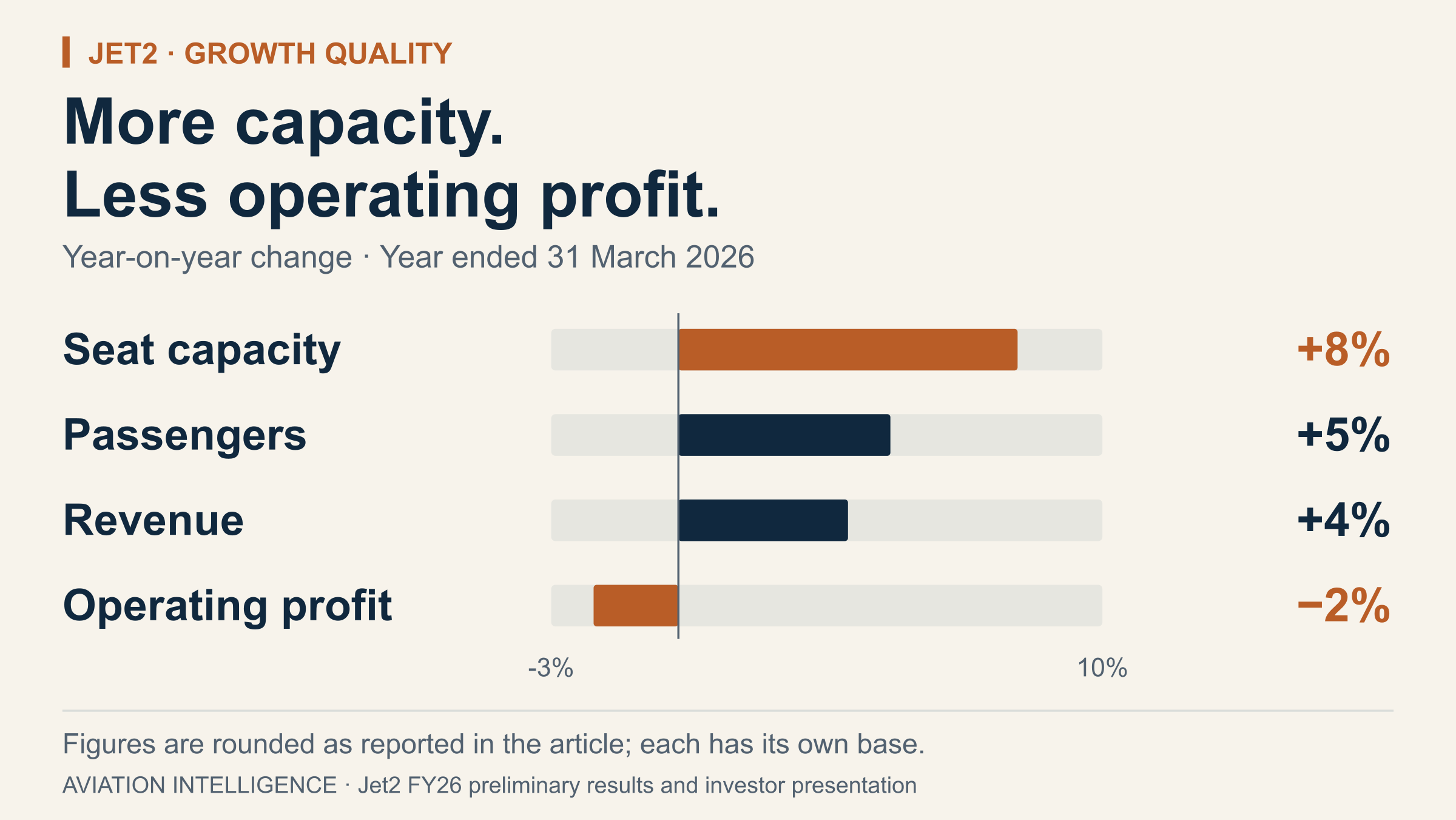
- Revenue: £7.48bn, up 4% year-on-year
- Passengers: 20.83m, up 5%
- Operating profit: £439.6m, down 2%
- Seat capacity: up 8%, to 24.0m seats
- Load factor: 86.8%, down from 89.8% the prior year
- Net cash: £2.01bn; cash and deposits of £3.29bn at year end
Chief Executive Steve Heapy described the capacity add as “disciplined, responsible expansion,” and the balance sheet supports that framing — Jet2 is not stretching to grow. But the load factor decline of three full points, alongside a 2% drop in operating profit on higher revenue, shows that the extra seats did not fill or convert as efficiently as the existing network. Growth and margin moved in opposite directions.

The part of the story that isn’t about strategy
Jet2‘s capacity has kept moving for a reason that has more to do with its supply chain than its commercial planning. The airline’s forward fleet is built entirely around the Airbus A321neo — 146 aircraft on order through 2035, with GE Aerospace and CFM confirming in mid-2026 that the entire A321neo order runs on the CFM LEAP-1A engine, not the Pratt & Whitney GTF.
That detail matters more than it might first appear. The two supply-side bottlenecks currently constraining European short-haul capacity are largely separate problems sitting on different airframes and engines: Boeing’s production shortfall on the 737 MAX, which has repeatedly forced Ryanair to cut its own passenger targets through 2026 as deliveries fell behind schedule; and the Pratt & Whitney GTF shortage, which has driven the grounding of newer A320/A321neo aircraft — including a meaningful share of Wizz Air‘s fleet — for engine inspections and repairs. Jet2‘s order book is an Airbus airframe paired with a CFM engine. It sits outside both queues at once. That is not a commercial insight Jet2 built; it is a sourcing decision, made years ago when the order was placed, that happens to have aged well.
None of this means Jet2 is immune to supply-chain risk generally — CFM’s LEAP line has its own backlog and has faced delivery-timing pressure across the industry. But it has not been party to either of the two specific shortages that this site has already documented as reshaping Ryanair‘s and Wizz Air‘s growth paths in 2026.
Where the growth actually came from — and what it cost
The FY26 results point to a second, less flattering explanation for the extra seats: Jet2‘s growth is increasingly weighted toward its lower-margin flight-only business rather than its package-holiday core. Flight-only passengers grew 15% year-on-year to 7.64m, while package-holiday customers grew just 1% to 6.62m. The package mix fell to 63.3% of customers, down from 66.5% the year before.
Layered on top of that mix shift was the cost of opening a new base. Jet2 launched operations at London Gatwick in late March 2026 with an initial six aircraft, and the results absorbed £11m of Gatwick start-up investment alongside £50m of industry-wide cost inflation — cited specifically as employment tax and sustainable aviation fuel costs. Chairman Robin Terrell called Gatwick “an important milestone in the execution of our long-term growth strategy,” which is true, but it is also, for now, a drag on group margin rather than a contributor to it.
Put together: Jet2 had the aircraft to grow when peers didn’t, but the growth it delivered leaned on a lower-yielding customer mix and a new base still in its investment phase. The capacity was available. Filling it profitably at the old rate was not automatic.
What the September update adds
Jet2‘s AGM trading statement, published September 3, 2026, is the freshest data point on the site’s board and points to some of FY26’s soft spots firming up. Summer 2026 seat capacity is now guided at 19.9m seats, up 7.6% year-on-year, with booked passengers up 8.8% — outpacing capacity growth, which would imply a load factor recovery versus FY26’s 86.8% if it holds. Management specifically flagged that the Gatwick operation is “performing ahead of expectations,” with a stronger package-holiday mix there than initially planned, and confirmed the base will grow to seven aircraft for Summer 2027.
Winter 2026/27 capacity is guided 8.0% higher year-on-year at 5.9m seats, with 0.4m of that concentrated at Gatwick — a signal that the base is being built out through the off-peak season rather than treated as a summer-only add. On costs, Jet2 has 93% of its full-year jet fuel requirement hedged at an average price of $753, and over 90% of foreign exchange exposure hedged, which limits how much of the current fuel and currency environment can move the FY27 numbers either way.
The next scheduled disclosure is the interim results for the six months to 30 September 2026, due November 18, 2026 — the first results release that will show whether the Gatwick package-mix improvement and the load-factor recovery implied by the September booking figures actually show up in the accounts.
Jet2 against the board
Ryanair is constrained by Boeing’s 737 MAX production shortfall and has repeatedly cut its own passenger targets as a result. Wizz Air is constrained by Pratt & Whitney GTF groundings and is recovering capacity unevenly as engines return from inspection. Jet2 is currently exposed to neither problem, and its FY26 and Summer 2026 capacity growth reflects that — but its pressure point is margin and customer mix, not supply (see the comparison table below).
The comparison is useful, but it shouldn’t be read as Jet2 having solved a problem the other two haven’t. It hasn’t faced the same problem. Its advantage is upstream of strategy, sitting in an order it placed years before the current shortages existed. What Jet2 has actually had to manage — margin dilution from a fast-growing, lower-yield segment, and the cost of standing up a new base — is a normal growth problem, and FY26’s numbers show it wasn’t managed for free.
What to watch next
Three things will say more about whether Jet2‘s position holds than anything in the FY26 numbers alone: whether the November 18 interim results show the load factor recovering toward the September booking trend rather than FY26’s 86.8%; whether Gatwick’s package-holiday mix outperformance, flagged in September, persists once the base scales past six aircraft; and whether the 146-aircraft A321neo order book stays clear of new engine or production disruption as CFM’s own delivery backlog is worked through elsewhere in the industry. Capacity that isn’t contested today can still become contested later — the LEAP-1A line is not immune to the pressures reshaping the rest of the supply chain, only currently outside the two specific ones binding Jet2‘s peers.
Primary sources
- Jet2 plc, Preliminary Results 2026 (year ended 31 March 2026)
- Jet2 plc, FY26 Investor Presentation
- Jet2 plc, AGM Trading Statement, 3 September 2026
- Jet2 plc Financial Calendar
- GE Aerospace, “Jet2 plc confirms LEAP engine for all its Airbus A321neo aircraft”
- FlightGlobal, “Ryanair lowers 2026 passenger target on Boeing delivery delays”
- Aviation Intelligence: The Capacity Airlines Cannot Buy
Figures are company-reported as cited in the primary sources above. Forward-looking capacity and cost statements remain subject to delivery, operational and demand risks. This article is for information purposes and is not investment advice.
Tables and key figures
Jet2 FY26 at a glance
| Metric | FY26 | FY25 | Change |
|---|---|---|---|
| Revenue | £7.48bn | £7.17bn | +4% |
| Operating profit | £439.6m | £446.5m | -2% |
| Passengers | 20.83m | 19.77m | +5% |
| Seat capacity | 24.0m seats | — | +8% |
| Load factor | 86.8% | 89.8% | -3.0pts |
| Net cash | £2.01bn | — | flat |
Capacity constraint comparison
| Airline | Constraint | Capacity direction | Source of pressure |
|---|---|---|---|
| Ryanair | Boeing 737 MAX delivery delays | Repeated passenger-target downgrades | Airframe production |
| Wizz Air | Pratt & Whitney GTF groundings | Capacity recovering, unevenly | Engine reliability/MRO |
| Jet2 | None of the above, currently | +8% seats (FY26), +7.6% guided (Summer 2026) | Margin and mix, not supply |
Leave a Reply