
Analysis date: 13 October 2026 · Airbus September data published on 8–11 October; Boeing third-quarter deliveries released on 13 October 2026.
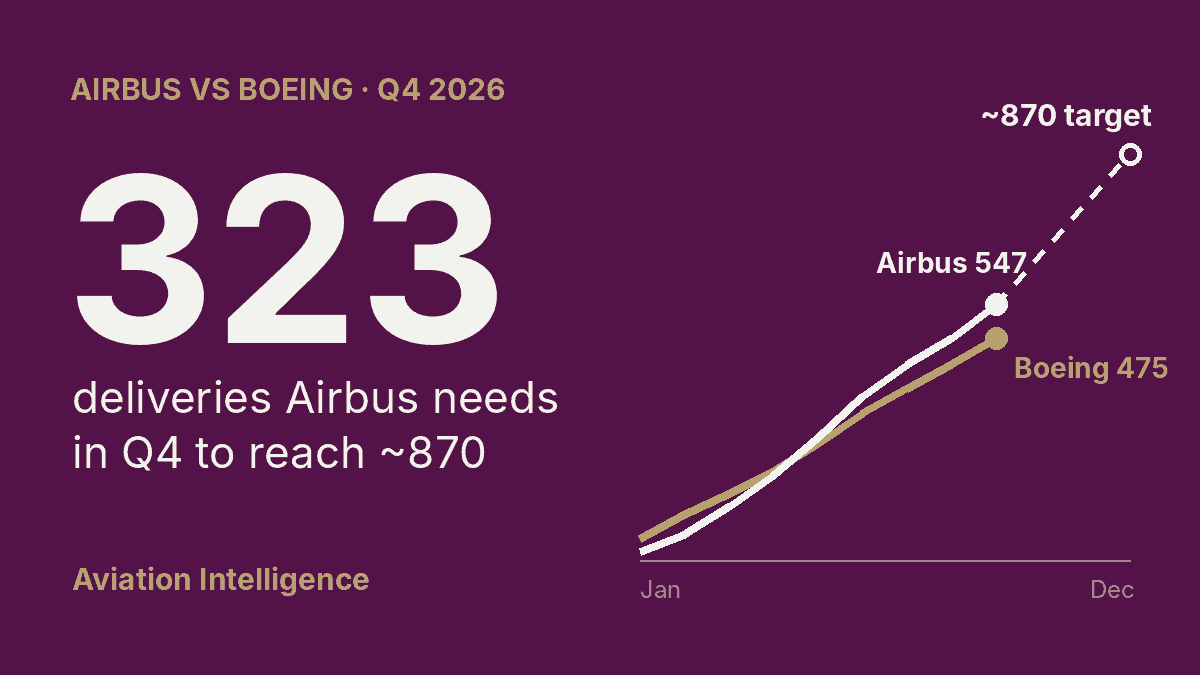
Airbus delivered 72 commercial aircraft in September, taking its total for the first nine months of 2026 to 547. That is 40 more than at the same point last year, and Airbus still guides to around 870 deliveries for the full year. The remaining requirement is the issue: 323 aircraft in the fourth quarter, or roughly 108 a month, against an average of 61 a month so far this year.
Boeing reported 57 deliveries for September on 13 October, its highest monthly total of 2026, and 161 for the third quarter. Its output is steadier than a year ago, but the third-quarter total was almost identical to the same quarter of 2025. Boeing is recovering in consistency more than in volume.
Both manufacturers matter beyond their own results. Airlines are planning their 2027 capacity around aircraft that have not yet been handed over, and every month of slippage has to be covered by older, less fuel-efficient aircraft, leases or reduced growth. In a year when fuel has become airlines’ largest cost pressure, the delivery schedule is also a cost schedule.

September in numbers
Airbus’s 72 September deliveries went to 37 customers and comprised 67 single-aisle and five widebody aircraft: two A330s and three A350s. The month was an improvement on August’s 57, but slightly below September 2025’s 73. Orders were unusually light, at 17 gross and 14 net after three cancellations. Aviation24.be, Airbus September data; AeroTime.
Boeing delivered 43 737s, eight 787s, two 777 Freighters and four 767s in September, three of the 767s for its defence business as KC-46 tankers. Gross orders reached 165, led by Turkish Airlines’ commitment for 100 737 MAX aircraft, and the backlog rose to 6,371 aircraft. Reuters via Investing.com; Boeing third-quarter deliveries.
| Measure | Airbus | Boeing |
|---|---|---|
| September 2026 deliveries | 72 | 57 |
| Third-quarter 2026 deliveries | 196 | 161 |
| Third-quarter 2025 deliveries | 201 | 160 |
| January–September 2026 deliveries | 547 (+7.9%) | 475 (+8%) |
| September 2026 gross orders | 17 | 165 |
| Backlog at 30 September 2026 | 9,310 | 6,371 |
| 2026 delivery guidance | Around 870 in total | No total target; ~500 737s and 90–100 787s |
Airbus’s lead in deliveries has widened from 51 aircraft at the end of July to 72 at the end of September. Over the same nine months, however, both manufacturers grew deliveries by about 8%. The gap reflects Airbus’s larger production system, not a faster recovery.
The arithmetic of a 323-aircraft quarter
Airbus’s year has followed an unusually steep curve. Deliveries rose from 19 in January to 89 in June as Pratt & Whitney engine supply improved, then fell back to 67 in July and 57 in August before recovering to 72 in September. That puts 114 deliveries in the first quarter, 237 in the second and 196 in the third. Air Data News, monthly deliveries to June; Forecast International, July data. The full monthly series, guidance-versus-actual record and our running delivery arithmetic are on the Airbus deliveries, orders and production rates page.
A year-end surge is normal at Airbus. In 2025 it delivered 286 aircraft in the fourth quarter, including 136 in December alone, after 201 in the third quarter. That was a step-up of about 42%. Reaching 870 in 2026 requires a step-up of about 65% from the third quarter, and a fourth quarter 37 aircraft larger than last year’s. Airbus FY2025 results; Aerospace Global News.
The monthly profile shows the scale of the task. If October and November each repeat September’s 72 deliveries, December would need 179, which is 43 more than December 2025. A more even path of about 108 a month would mean Airbus sustaining a rate it has not reached in any single month this year.
| Fourth-quarter scenario | Q4 deliveries | Full-year 2026 |
|---|---|---|
| September’s pace held for three months (72 × 3) | 216 | 763 |
| 2025’s third-to-fourth-quarter step-up repeated (×1.42) | 279 | 826 |
| 2025’s fourth-quarter volume repeated | 286 | 833 |
| Required for guidance of around 870 | 323 | 870 |
| Required for the internal objective of more than 900 reported by Reuters | 353+ | 900+ |
Each reference point based on 2025 performance lands between 826 and 833 aircraft. That would still be about 4–5% more deliveries than 2025’s 793, but some 40 aircraft short of guidance. Airbus has to beat its 2025 year-end by a clear margin rather than simply repeat it.
Airbus is publicly confident. Lars Wagner, chief executive of Airbus Commercial Aircraft, said he was “very confident” the target would be met, and the guidance was unchanged at the half-year results on 29 July. In July Reuters reported an internal objective of more than 900 deliveries. On September’s figures that objective now looks out of reach, and the published guidance has become the real test. Aerospace Global News; Air Data News citing Reuters.
What stands between Airbus and the target
Engines remain the binding constraint on the A320neo family. In February Airbus said Pratt & Whitney’s failure to commit to the engine volumes it had ordered was weighing on its 2026 guidance and ramp-up. By the end of July, chief executive Guillaume Faury said Airbus no longer had aircraft ready for handover and waiting only for engines, and that the agreed engine quantities supported guidance. Airbus still has no buffer of Pratt engines, however, so any shortfall in supply in the fourth quarter falls directly on deliveries. Airbus FY2025 results; Airways Magazine, H1 results call.
Component quality has moved work into the fourth quarter. Reuters reported that quality problems with A321neo components pushed about 20 aircraft from the third quarter into the fourth. That helps explain September’s figure, but it also raises the fourth-quarter requirement. Those aircraft still have to be completed and handed over alongside normal production. Aerospace Global News citing Reuters.
The A330neo lost two months. Deliveries were suspended in June and July after a tool was found inside an aircraft’s tail section, and resumed in August. Airbus has delivered 13 A330s so far this year, against 20 in the same period of 2025. Reuters reported that about 160 aircraft, including military variants, could be subject to inspection. The A330 is a small share of Airbus’s volume (see the programme-by-programme split on our Airbus tracker), but every widebody delivery carries a much higher value than a single-aisle aircraft. Aerospace Global News.
Inventory cuts both ways. Forecast International’s September tracking shows the A320neo family still struggling to reach its target production rate of 50 a month consistently. It also shows widebody inventory across the industry at 158% of combined monthly target rates, attributed to cabin-interior and seating bottlenecks. Aircraft that are built but not delivered represent Airbus’s best route to a large December, because much of the work is already done. The same backlog shows how much depends on suppliers outside the final assembly lines. Forecast International, September 2026.
Boeing: steadier, not yet faster
Boeing’s monthly deliveries were 53 in July, 51 in August and 57 in September. The resulting third-quarter total of 161 is one aircraft more than the same quarter of 2025. Year-to-date deliveries of 475 are 8% higher than in 2025, and 737 deliveries of 367 so far this year are a strong nine-month result for the programme. Boeing third-quarter deliveries; Reuters. Monthly deliveries, programme and certification status, and backlog value are tracked on our Boeing deliveries and production rates page.
The next step is harder. Boeing delivered 124 737s in the third quarter, about 41 a month. On 16 September chief executive Kelly Ortberg said the 737 line was “not stable yet” at 47 a month, with wing production in Renton the immediate constraint. The move to 52 a month depends on certifying a new line in Everett and, according to Leeham News, now looks unlikely by the end of 2026. Leeham News. We covered the cash implications in Boeing’s cash recovery is moving slower than its production plan.
Boeing has a source of upside that Airbus lacks. It has built more than 30 737-7 and 737-10 aircraft that are awaiting certification-related clearance. The 737-7 received an amended type certificate in August, and those deliveries are expected to begin early next year. Releasing that inventory could lift 2027 deliveries above the production rate. The 737-10, by contrast, remains in certification, a risk we examined in The 737 MAX 10 delay: why it matters.
On the widebody side, Boeing delivered 22 787s in the third quarter, a little over seven a month, consistent with a stated rate of eight while GE engine supply limits a move to ten. Boeing does not set a target for total deliveries, but management has pointed to about 500 737s and 90–100 787s this year. With 367 737s and 62 787s delivered to September, that implies roughly 133 737s (about 44 a month) and 28–38 787s in the fourth quarter: a smaller step-up than Airbus needs, but faster than either programme has managed in any quarter this year. AirInsight, Boeing 2026 delivery guidance. At September’s pace Boeing would deliver roughly 640–650 aircraft in 2026, an illustrative run-rate and not a forecast.
A quiet order month is not a demand signal
Airbus’s 17 September orders were its lowest monthly total of the year. Nine-month gross orders, however, stand at 1,174, and net orders of 1,105 are more than double the 514 recorded at the same point in 2025. Orders tend to cluster around air shows and large campaigns: July alone brought 204 during Farnborough. On 9 October Airbus announced a firm order from lessor Avolon for 110 aircraft, 35 A330-900s and 75 A320neo-family jets, which will be counted outside the September figures. Aerospace Global News; Airbus, Avolon order.
The demand question is more complex than one month’s orders. IATA’s June outlook expected the fuel shock to roughly halve industry profit in 2026. Weaker earnings can delay airline orders, but high fuel prices also widen the cost advantage of new-generation aircraft over the ones they replace. Lessors such as Avolon are positioning for that replacement demand. IATA June outlook. With backlogs of 9,310 aircraft at Airbus and 6,371 at Boeing, both manufacturers have many years of work at current rates. The near-term limit is production, not demand.
What a miss would — and would not — mean
For Airbus, deliveries drive revenue and cash, because a large share of the aircraft price is paid on handover. Its 2026 guidance of around €7.5 billion of adjusted EBIT and around €4.5 billion of free cash flow before customer financing assumes the delivery target. A shortfall of 30–40 aircraft would move some revenue and cash into 2027 rather than remove it, but it would test how firm the guidance language is. Airbus H1 2026 results.
For airlines, the effect is about timing. An aircraft due in December that arrives in February misses the start of a schedule season and may delay retirements of older, less efficient aircraft. Engine and aircraft availability, more than order books, often decides which carriers can grow, as our analysis of Jet2’s capacity and of fleet availability showed.
For the competitive balance, a miss would not change the structure of the market. Airbus would still deliver more aircraft than Boeing in 2026, as it has every year since 2019; our aircraft manufacturers overview sets both against COMAC, Embraer and ATR. What would change is the narrative: Airbus’s problem would look less like a supply chain that is slowly recovering and more like a production system that cannot yet absorb the volumes it has sold.
What to watch next
The next three weeks will show whether the fourth-quarter plan is on track. Five signals matter most:
- Boeing’s third-quarter results on 27 October: any update on stabilising the 737 at 47 a month, on Everett line certification and on 787 engine supply.
- Airbus’s nine-month results on 28 October: whether “around 870” is reaffirmed without qualification, softened, or replaced with a range.
- October deliveries, published in early November: the closer the month comes to 108, the less Airbus depends on an outsized December.
- Pratt & Whitney engine flow: any shortfall feeds directly into A320neo-family deliveries, because Airbus holds no buffer.
- A330 inspections and cabin interiors: how quickly widebody inventory turns into handed-over aircraft.
Airbus has delivered strong final quarters before, and aircraft already built but not yet handed over give it material for another. The 2026 target nevertheless requires a year-end that is bigger than 2025’s, not merely as good. Boeing’s challenge is different: it has stabilised, and now has to turn stability into higher volume.
RELATED RESEARCH
Track Airbus deliveries, orders and production rates · Track Boeing deliveries, backlog and production rates · Compare all five aircraft manufacturers · Read why fleet availability matters more than the order book
Methodology and scope
Delivery and order figures are taken from manufacturer releases and from reporting of Airbus’s monthly data, checked on 13 October 2026. Airbus’s quarterly totals for 2026, and its third-quarter 2025 total, are calculated by Aviation Intelligence from reported monthly and cumulative figures. Boeing’s quarterly figures are as reported in its third-quarter deliveries release, which the company describes as provisional until its quarterly results are issued.
The fourth-quarter scenarios and Boeing’s annual run-rate are arithmetic illustrations based on stated assumptions. They are not forecasts by Aviation Intelligence or the manufacturers. Statements attributed to Reuters, Leeham News and Forecast International reflect those organisations’ reporting and have not been independently verified.
Primary sources
- Boeing · Third-quarter 2026 deliveries — 13 October 2026.
- Airbus · Orders and deliveries — September 2026 data.
- Airbus · Half-year 2026 results — 29 July 2026.
- Airbus · Full-year 2025 results — 19 February 2026.
- Airbus · Avolon orders 35 A330-900 and 75 A320neo Family aircraft — 9 October 2026.
- Reuters · Boeing delivers 57 jets in September — 13 October 2026.
- Aerospace Global News · Airbus needs 323 deliveries in Q4 — October 2026.
- AeroTime · Airbus September 2026 deliveries — October 2026.
- Leeham News · Rate of 47 MAX jets per month still eludes Boeing — 16 September 2026.
- Forecast International · September 2026 manufacturing intelligence — 5 October 2026.
- IATA · June 2026 airline industry outlook — 7 June 2026.
Note: This analysis reflects information available on 13 October 2026. Delivery figures may be revised by the manufacturers. Forecasts and guidance are subject to production, supply-chain and certification risks. This article is for information purposes and is not investment advice.
Leave a Reply